
NAPA Change Management Reduces PACU Length of Stay, Driving Measurable Increases in Efficiency and Improving Satisfaction
Overview
NAPA has a strong track record of implementing successful perioperative change management at our nearly 400 healthcare partner sites. Our effective infrastructure supports sharing best clinical and operational practices across our national network, leveraging the expertise of our approximately 5,000 anesthesiologists, certified registered nurse anesthetists (CRNAs), and certified anesthesiology assistants (CAAs), as well as our locally focused business and client services leaders.
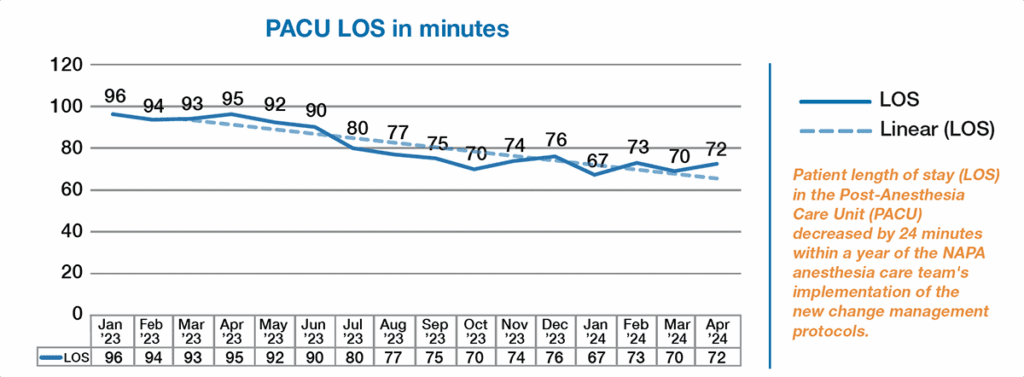
When Alan J. Sim, MD, FASA, joined Mount Sinai South Nassau (MSSN) Hospital as NAPA Chairman of the anesthesiology department, he soon recognized how delays in discharging patients from the Post-Anesthesia Care Unit (PACU) were impeding surgical case flow and creating dissatisfaction among surgeons, patients, and perioperative staff. Working collaboratively with interdisciplinary stakeholders, Dr. Sim identified the roadblocks and implemented an array of clinical solutions and process improvements that reduced patient hold times in the PACU by 30 to 40 minutes, without impacting clinical outcomes. After Dr. Sim’s team replicated this success for endoscopy patients’ length of stay (LOS), other hospital service lines now turn to the NAPA anesthesia team for their perioperative expertise and operational guidance.
Situation
A confluence of clinical and operational factors was holding up patient discharges in the MSSN PACU. Whether due to shortages in staffing, technology, or communication, or the additional time it took patients to recover from inhaled anesthesia and/or pain management narcotics administered during procedures, the result was the same: Patients were waiting 100 to 110 minutes to be discharged from the PACU—and while these patients awaited discharge orders, new patient throughput from operating rooms (ORs) backed up, further delaying surgical procedures and creating more problems for surgeons and clinical staff.
Solution
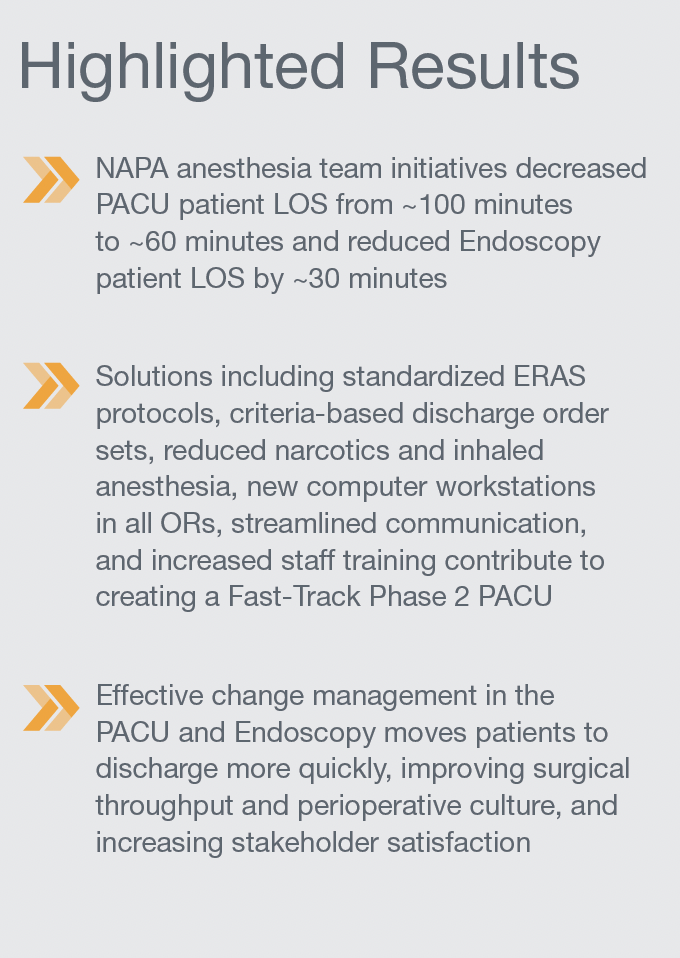
Dr. Sim and the NAPA anesthesia team worked closely with Nicole Ng, MSSN Director of Perioperative Services; Manuela Ignacio, MSN, RN, PACU Administrative Nursing Supervisor; and a team of clinical leaders to overcome the obstacles to patient discharge. One obvious problem was a lack of computers, which held up documentation and order requests. Adding stationary workstations to every OR sped up orders and also improved infection control with more efficient cleaning processes, as opposed to cleaning the mobile tablets that were previously in use. Additionally, instead of relying on the availability of a physician to sign off on discharge orders, the PACU team adopted a discharge protocol using predefined clinical criteria, which enabled PACU nurses to discharge qualified patients more quickly.
Innovative efforts to move patients through the PACU more quickly included switching to single-use equipment that reduced the amount of time it took nurses to put new monitors on patients every time they changed locations. Dr. Sim also instituted new ERAS (Enhanced Recovery After Surgery) protocols, which enabled using shorter-acting anesthetics, running less inhaled anesthesia, and reducing narcotics, allowing patients to wake more quickly in the PACU. Working together, the team streamlined internal communication and added new training so that everyone understood and participated in the new procedures. With this comprehensive approach, the NAPA anesthesia team reduced patient time in the PACU, and again in the Endoscopy PACU, by approximately 30 to 40 minutes.
“People always talk about making ORs run more efficiently. You have to start with the PACU first, because that’s really where you run into bottlenecks. When patients get held in the PACU due to a lack of space or staff, surgeries get delayed and everyone is dissatisfied. NAPA looks at perioperative services with a global perspective, clinically and operationally, from pre-op to intra-op and post-op. With PACU success, we are applying our standardized approach to improving OR efficiency.”
— Alan J. Sim, MD, Chairman of Anesthesiology
Mount Sinai South Nassau Hospital
Results
Effective change management is facilitated by strong leadership, data-driven evidence, and empathy for all the stakeholders who might participate in and be impacted by proposed process improvements. Beyond their clinical expertise, NAPA’s anesthesia leaders receive extensive education in business and communication skills, so they can better contribute to helping hospitals achieve their operational goals.
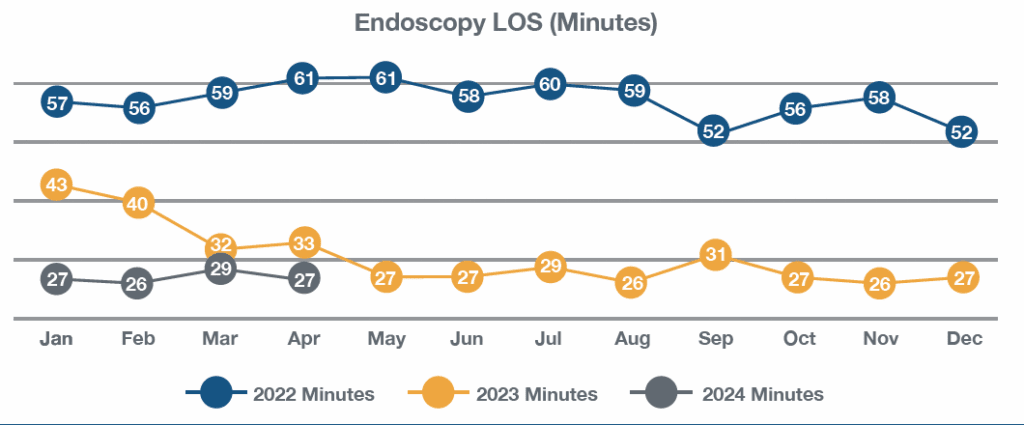
Successful results speak for themselves: Jennifer Fuentes, BSN, RN, CGRN, Endoscopy Nurse Manager, says, “At MSSN, the interdisciplinary teams work collaboratively to optimize patient care safely. Dr. Sim and his NAPA team’s expertise and abilities have helped in managing departmental resources effectively. They have streamlined processes within the Endoscopy unit. For instance, they have implemented strategies to minimize wait times between procedures, ensuring that patients move through the department smoothly and efficiently. Additionally, they collaborate closely with other healthcare professionals to coordinate care plans for patients with complex medical histories or multiple procedures scheduled on the same day. Moreover, Dr. Sim and his team have embraced evidence-based practices to enhance patient outcomes while minimizing risks associated with anesthesia administration. These practices include utilizing advanced monitoring technologies during procedures and employing standardized protocols for anesthesia delivery based on each patient’s unique needs. By adhering to these evidence-based practices, they ensure that patients receive high-quality care while maintaining safety standards within the department. The impact of these improvements can be seen in the Endoscopy department’s performance data. This achievement is a testament to Dr. Sim’s leadership and the dedication of his NAPA team in continuously striving for excellence within the Endoscopy department at MSSN.”
“Overall, the economic value of the NAPA anesthesia providers at MSSN cannot be overstated; their presence not only enhances patient care and safety, but also results in cost-effective and efficient operations for the PACU.”
–Travis Marballie, MBA-HCM, RN, CPAN, Asst. Nurse Manager, PACU
Mount Sinai South Nassau Hospital, Oceanside, NY
Let’s Connect | 833-OR1-TEAM | Solutions@NAPAanesthesia.com