
Path to Leadership: Excellence earns respect
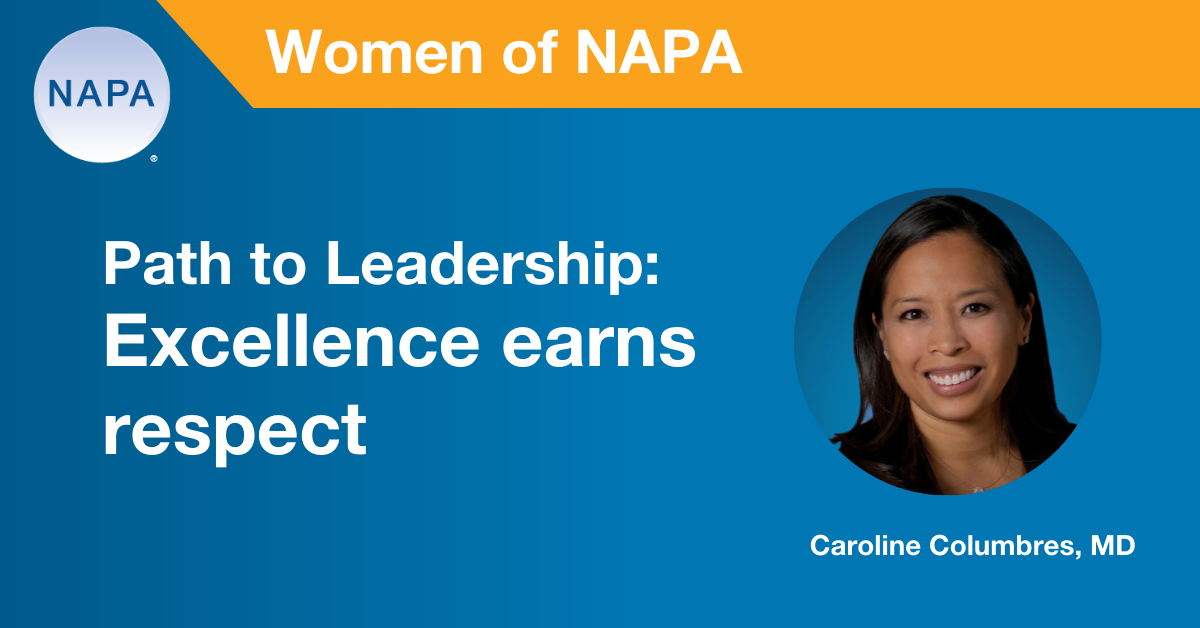
We celebrate women across our NAPA family. In this Women of NAPA series: Paths to Leadership, we share stories of challenges, successes, and lessons learned on the career journeys of women throughout our organization.
By Caroline Columbres, MD
Chair of Anesthesia, Brooklyn Hospital Center
Once I arrived in Brooklyn to do my residency, I never left. When I got my first attending job, I remember thinking: “I really, really like this hospital.” I liked the people, and I liked the workflow, so I stayed. Eleven years later, I am now the anesthesia chair.
After beginning as a rookie attending anesthesiologist, I graduated to floor runner, and from floor runner, I got promoted to be vice chair. In 2019, I was promoted again, this time to chair. This made me feel a bit like the ball boy on a baseball team—suddenly promoted to manager and running things. The administration knew who I was because I often pitched in at meetings for the former chair. I’ve seen surgery residents becoming attendings, and then become my colleagues. This job isn’t for everyone, but for me it’s been a perfect fit.
In terms of what enabled me to grow into a leadership role, first and foremost, I was always invested in the job. Whenever I was at work, I was fully present and focused on doing what was best to make the operating room (OR) run smoothly. I would help nurses and surgeons, doing whatever was needed.
Do the hard things
A secret to success for me was being willing to sometimes do uncomfortable things. Early on, my goal was to become comfortable as an attending. I knew I would never be comfortable until I did the hard things. I volunteered to take the challenging cases because I wanted to learn, and I wanted to push myself. I didn’t run away from danger: I ran towards it.
One of the biggest obstacles I faced—as not just a woman, but as a woman of color—was moving from being a regular attending into a position of “power.” It took time to earn the respect of a few colleagues with complex personalities. Instead of letting this stop me, I knew success lay in the only thing under my control: Excelling at my work. That meant making extra sure the patients of these colleagues had good outcomes, and anesthesia was never a reason for a complaint. In the end, I earned their respect.
Set healthy boundaries
For others looking to grow as a leader, the best piece of advice I would give is this: You cannot be all things to all people. That means putting up some boundaries. You will try your best, but you cannot fix OR efficiency in one day. You will try your best, but you cannot end a pandemic. You can do the right thing in any given situation, and you can try to lead and hope other people follow you.
Sometimes, it might not work out, and that’s OK if you tried your best. Doing that means you can sleep better at night. It’s important not to beat yourself up when things work out differently than planned.