
The Anesthesia Lens: 5 Strategic Decisions That Shape Surgical Success for De Novo Hospitals
By Clavio Ascari, MD, NAPA Chief Clinical Officer

Planning a de novo hospital is a multi-year endeavor marked by architectural drawings, capital allocations, regulatory hurdles, and service line strategy. Yet one of the most significant determinants of sustainable surgical performance is often underrepresented in early conversations — insights from anesthesiology.
Surgical services remain the primary revenue engine for most hospitals. At the same time that demand for procedures continues to rise, anesthesia workforce constraints are projected to persist for years. In this environment, decisions made during the earliest planning phases can quietly determine whether a new hospital opens with built-in efficiency, or built-in bottlenecks.
Viewing de novo development through the anesthesia lens brings clarity to five strategic decisions that shape throughput, workforce sustainability, and financial performance.
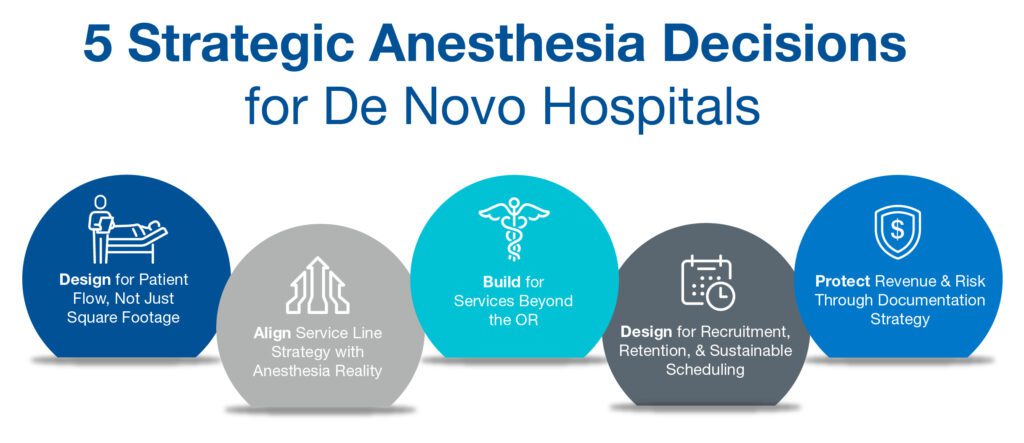
1. Design for Patient Flow, Not Just Square Footage
Success in the operating room (OR) does not begin when the doors open. It begins when blueprints are designed. Patient flow must move seamlessly from pre-anesthesia assessment to pre-op holding, to the operating room, the post-anesthesia care unit (PACU), and ultimately to discharge or inpatient placement. When these areas are geographically fragmented or poorly sequenced, small delays are compounded throughout the day, affecting every room, every case, and ultimately revenue velocity.
Proximity between pre-op, ORs, PACU, and critical service areas reduces handoff friction and prevents avoidable downtime. Even minor design inefficiencies can become permanent structural barriers to throughput. Over time, those minutes translate into fewer cases per day and diminished surgical growth.
Throughput is not simply an operational issue. It is an architectural one.
2. Align Service Line Strategy with Anesthesia Reality
Many de novo hospitals are built with growth ambitions in mind—cardiac programs, advanced orthopedics, minimally invasive procedures, and other high-acuity services. Each of these carries specific implications for the anesthesiology department.
High-acuity service lines often require dedicated space for invasive line placement, regional anesthesia programs, and expanded preoperative optimization. If pre-op capacity is undersized or not designed for adequate procedural preparation, tasks may migrate into the OR for work that should have been completed earlier. This can have an impact on turnover times and increase costs.
Strategic growth projections must also be aligned with workforce realities. Expanding surgical volume without commensurate increases in anesthesia capacity creates strain on staffing models and undermines performance from day one.
Service line growth and anesthesia infrastructure must be developed in parallel.
3. Build for Services Beyond the OR
Anesthesia care is not confined to the operating room. Non-operating room anesthesia (NORA) services, such as those required within cath labs, interventional radiology, GI suites, labor and delivery, and procedural areas, continue to expand across health systems.
Designing these areas without considering their proximity to the OR core often results in redundancies of staffing, inefficiencies, and higher labor costs. When NORA locations are strategically positioned near the central anesthesia team, coverage models can be optimized, inefficiencies minimized, and workforce utilization improved.
As procedural volume continues to migrate outside traditional ORs, flexibility in layout becomes a long-term financial safeguard. NORA expansion is predictable and necessary. Designing for it should be intentional.
4. Design for Recruitment, Retention, and Sustainable Scheduling
Anesthesia workforce shortages are unlikely to ease in the near term. Recruitment and retention are no longer simply talent acquisition challenges—they are infrastructure decisions.
The physical environment influences clinician satisfaction. Adequate workspace, organized anesthesia stations, functional pre-op areas, and thoughtful layout all contribute to a professional setting that attracts anesthesia clinicians rather than alienating them.
Equally important is a department’s leadership structure and scheduling infrastructure. Engaged physician and advanced practice leadership—aligned under a cohesive care model—establish the culture that drives long-term retention, allowing for enhanced recruitment. Scheduling systems and workforce management tools must be in place prior to go-live to ensure equitable coverage, prevent burnout, and reduce unnecessary reliance on locum tenens support.
In systems operating multiple facilities, geographic proximity can further enhance flexibility through provider cross-credentialing and volume smoothing. Workforce sustainability does not begin with recruitment efforts. It begins with layout decisions.
5. Protect Revenue and Risk Through Documentation Strategy
Technology choices made during construction planning carry lasting financial implications.
The selection and implementation of an anesthesia record system directly affect revenue capture, quality reporting, compliance, and medicolegal defensibility. Incomplete or inaccurate documentation does not simply leave revenue on the table; it also increases exposure to legal risk and has a direct impact on the cost of delivering care.
Whether integrating an anesthesia module within a broader enterprise EMR or selecting an alternative charting solution, leaders must evaluate how documentation workflows support accurate billing, regulatory compliance, and defensible clinical records. Documentation decisions carry great financial importance, both from a primary revenue capture perspective and via overall risk mitigation.
Remembering the Anesthesia Lens
De novo hospitals represent opportunity, with new markets, expanded access, and surgical growth. But surgical success is rarely determined after opening day. It is shaped during the earliest design meetings, staffing discussions, and technology selections.
The anesthesia perspective intersects physical layout, service line strategy, workforce planning, throughput optimization, and financial integrity. Hospitals that incorporate anesthesia expertise early in the planning process are better positioned to avoid costly redesigns, staffing instability, and operational drag.
As development progresses, confirming that key decisions are evaluated through the anesthesia lens can help safeguard surgical efficiency, workforce sustainability, and long-term performance from day one.
Dr. Ascari serves as NAPA’s Chief Clinical Officer, where he leads clinical strategy, quality oversight, and consulting services for hospitals and health systems. Drawing on decades of experience in anesthesiology and operational leadership, he partners with executive teams to strengthen surgical throughput, workforce sustainability, and perioperative performance. Leaders planning de novo facilities or those addressing challenges within existing operations may benefit from engaging anesthesia expertise early in the process. Interested in a conversation? Connect with us.