NAPSI Leadership & Quality Innovation Produces Anesthesia Risk Alerts, an Effective Safety Intervention for High-Risk Patients
Overview
In 2019, NAPA created its own Patient Safety Organization (PSO), the NAPA Anesthesia Patient Safety Institute (NAPSI). NAPSI is one of only ~100 PSOs federally certified by the Agency for Healthcare Research and Quality (AHRQ). Through its affiliation with NAPSI, the clinical entity of NAPA’s anesthesia practice is able to use clinical outcomes data for analysis and performance improvement activities.
NAPSI maintains one of the nation’s largest anesthesia clinical outcomes database, comprising data from more than 2 million patients served by NAPA’s ~5,000 clinicians each year. NAPA is also committed to improving healthcare quality and reports quality measures to the Merit-Based Incentive Payment System (MIPS) under the CMS Quality Payment Program (QPP).
Standardized approaches improve clinical outcomes by reducing variability across the perioperative care continuum. Seeking to reduce the incidence of critical events in high-risk patients, NAPSI conducted a systemwide review of NAPA clinicians’ adverse events. Its research identified five high-risk clinical scenarios that contributed to significant adverse events at healthcare institutions nationwide. NAPSI developed the Anesthesia Risk Alerts (ARA) program leveraging this data with clinical expertise. This patient safety intervention was subsequently implemented in all of NAPA’s clinical sites, including nearly 400 hospitals and ASCs in 22 states.
This Quality Improvement (QI) initiative demonstrates how NAPA’s inspired leadership, digital innovation, and effective education, in collaboration with NAPSI, its PSO partner, created mitigation strategies that reduce critical events. The ARA initiative also fosters collaborative cultures among healthcare providers, improving workplace environments, which has been shown to improve patient care.
Situation
Barriers to collaboration have been identified across various industries. In the operating room (OR), patient safety may be compromised by a lack of trust or respect, misaligned goals, knowledge deficits, or poor communication skills.
After examining adverse-event analytics, NAPSI developed a strategy to improve OR safety for high-risk patients. For complex patients, this included a standardized approach incorporating risk assessment, clinical collaboration, and a decision-making process that optimizes analytical thinking and produces better clinical outcomes. This data-driven research and professional best practices led to the ARA program, an innovative, patient-first, QI initiative that is reducing the incidence of serious adverse clinical events across NAPA’s partner facilities.
Solution
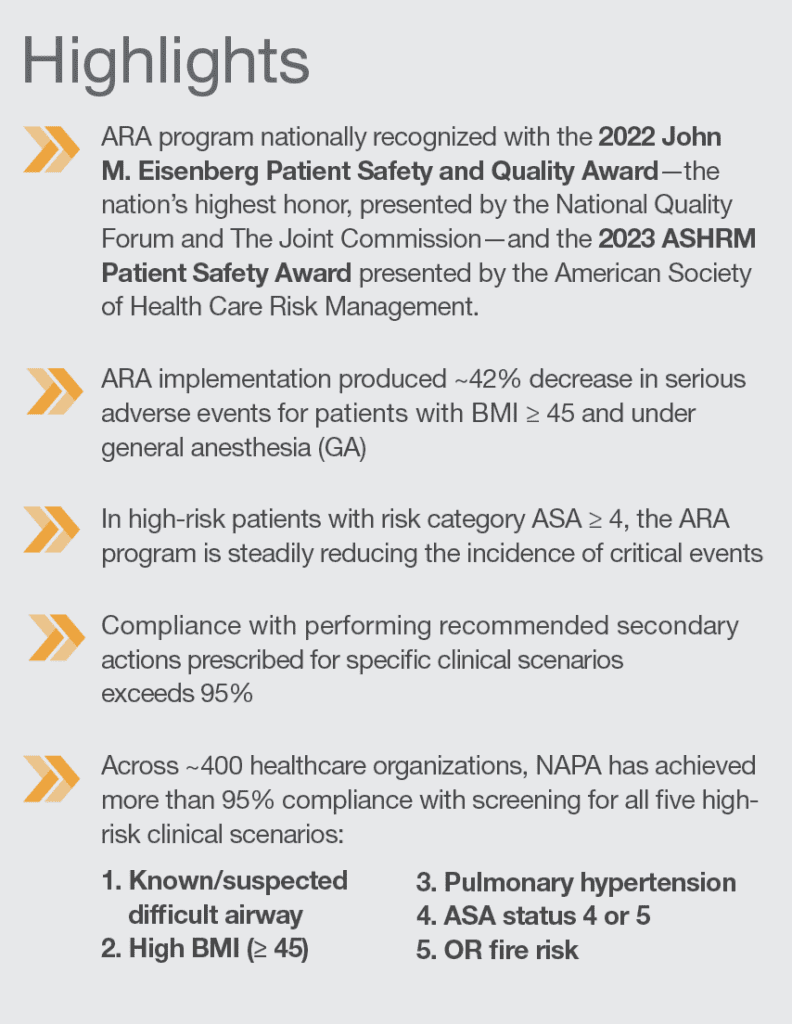
The ARA program encourages that prior to undergoing an anesthetic, each patient is assessed by the anesthesia clinician for five high-risk clinical scenarios. If one or more is present, the anesthesia clinician is encouraged to perform a specific mitigation strategy defined for each ARA, as follows:
- Known/suspected difficult airway: second practitioner present to assist for induction and emergence for all general endotracheal anesthetics
- High BMI (> 45): second practitioner present to assist for induction and emergence for all general anesthesia cases
- Pulmonary hypertension: consultation about the case with a second clinician
- Risk category ASA status 4 or 5: consultation about the case with a second clinician
- OR fire risk: follow fire mitigation protocols as prescribed by the local institution
ARA compliance is digitally tracked on every anesthetic case across NAPA partner sites to track assessment compliance for these high-risk scenarios, and that the suggested risk mitigation strategy is being applied. NAPA’s local leadership (Anesthesia site chiefs or Quality site leaders) receive regular feedback on these metrics to discuss outcomes with their providers on an ongoing basis, and all NAPA clinicians receive monthly feedback about their individual performance via data on their compliance with the ARA program.
Transforming Culture
NAPSI’s ARA program is innovative in how it routinely collects data about adverse events and applies this information into actionable mitigation strategies. ARA also utilizes novel approaches to patient safety adopted from other fields, including medical decision-making, cognitive errors, dual process model of reasoning, and blue team/red team challenge methodology.
Uniquely, each ARA mitigation strategy requires collaboration with other healthcare providers. As needed, difficult airway assistance can be rendered by the circulating nurse, endoscopy nurse, OR technician, labor and delivery nurse, or even the surgeon. The only suggestion is that the second clinician should be knowledgeable and skilled enough to actually assist with the airway management, and that they be fully available at the time of induction and emergence to assist if needed. Prevention of OR fires requires collaboration among all members of the OR team.
Because this program is intrinsically collaborative, it has fostered a culture of collaboration in which clinicians have begun to discuss cases with colleagues or ask for assistance, even in cases that are not identified as “high risk” under the ARA program. Breaking down organizational, cultural, and interpersonal barriers to workplace collaboration in healthcare settings adds value to the clinical benefits that the ARA program brings to NAPA’s hospital and ASC partners.
Results
ARA includes educational video training for all NAPA anesthesia clinicians. The goal to achieve universal compliance is more likely to succeed when clinicians understand the rationale behind the risk mitigation strategies.
Since implementing the ARA program, compliance with both the assessment of all anesthesia cases for the five high-risk clinical scenarios and the performance of the recommended secondary action has risen to approximately 95%.Preliminary analyses of critical adverse events related to both high-BMI patients and patients presenting as ASA 4 or 5 have shown a decrease in the number of relevant critical events over time. Improved clinical outcomes produce better operational and financial results by reducing complications that may inhibit recovery, increase inpatient length of stay, or lead to hospital readmissions that may incur CMS penalties.
Quality is the backbone of our organization. The Anesthesia Risk Alert program is a testament to the fact that everything we do is about delivering quality for our patients and providers. When we have severely ill patients with complex anesthetic plans, the ARA protocol encourages a pause, to allow clinicians to come up with the best possible plan for those patients. This program saves lives.
— Rafael Cartagena, MD, Chief Executive Officer, NAPA